
Every driver in the UK has a legal responsibility [1]
to take the correct steps after a car accident. Following the proper process ensures road safety and a smooth claims procedure.
After an accident, it is a legal requirement to stop as soon as it is safe to do so [2]
. Even if the accident seems minor, it’s always best to stop. Give yourself a moment to collect your thoughts.
Taking a moment to breathe and staying focused on clear communication can make a big difference. Document key details at the scene and encourage a calm environment – this helps prevent unnecessary stress and ensures that everything is handled efficiently.
First and foremost, check yourself, passengers, and anyone else involved for any possible injuries.
If you notice any injuries, no matter how minor they seem, your top priority should be to dial emergency services and request an ambulance. Clearly mention that you’ve been in a car accident and provide them with your location details as accurately as you can.
If it seems like there aren’t any injuries at the scene, it’s a good idea to make a note of that fact. This detail can be vital during the claims process, particularly if there are disputes or claims related to injuries later on.
If you’re in doubt about any potential injuries, err on the side of caution and call emergency services regardless. It’s always better to be safe.
Use the ‘what3words’ app or website if you’re struggling to pinpoint your location. Emergency responders widely use this system, which divides the world into 3m x 3m squares, each assigned a unique three-word address. Sharing these three words allows you to provide precise location details to the emergency team quickly and accurately.
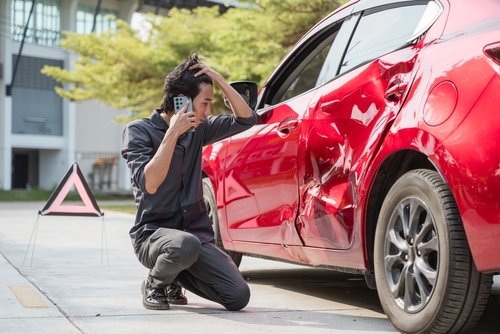
It’s natural to want to say “sorry” after an accident, even if you’re not sure what exactly happened. But it’s wise to hold off on apologising.
Sometimes, people say sorry just out of habit or shock, even if the accident wasn’t their fault. But be careful: others might take your apology as you saying it was your fault, and that can cause issues when it’s time to sort things out with insurance.
If the other driver says they’re sorry or mentions anything about the accident, it’s a good idea to remember what they said and when. This can be helpful later on.
It’s also smart to have someone around who saw what happened, like a witness. They don’t need to know all the rules about accidents, but their memory of the event can help clear things up if needed.
If you’re worried someone might be hurt, always call for help. At the end of the day, everyone’s safety is the most important thing.

The decision to involve the police depends on the circumstances of the car accident. If you decide to report the accident to police, always aim to do this within 24 hours according to the police instructions [2] .
Situations where you should call the police
In certain situations following a non-fault accident, calling 999 is the best option. These include:

Once the initial shock has subsided and everyone is safe, it is a legal requirement for both drivers to exchange details [3] . This is very important for a successful non-fault claim. These details must include the following:
Driver’s full name
Driver’s telephone number(s)
Vehicle registration number
It’s also wise to jot down the other driver’s insurance company name. This can be handy if you have trouble getting in touch with the driver later on.
Remember to both collect the other driver’s details and provide your own. It’s an offence not to share your details after a car accident. Failing to do so could not only land you in hot water but might also affect any accident claim you make later.
For a smooth claims process later on, keep the details you’ve collected safe. If you can, save them electronically by sending yourself an email or saving them in cloud storage.
While it’s always good to have a paper and pen for things like sketches (see our section on what information to jot down), remember paper can get lost or damaged easily. So, it’s best to keep a backup.
Having independent witnesses can be crucial in proving what really happened in an accident.
A strong witness statement can help support your claim, especially when there are disputes over fault.
If there were any bystanders who saw the accident, be sure to collect their full details, including their name, contact information, and a brief account of what they saw.
Ask the witness if they would be willing to assist further if needed by providing a statement or speaking a company like ourselves.
Gathering evidence at the accident scene helps prove you were not at fault and increases your chances of a successful claim.
Information to collect:
Take note of all third-party vehicles involved, including make, model, colour, year, and registration plate.
If anyone is injured, make sure to make a note of this. In addition, if people weren’t injured, make a note of this also.
If your vehicle has a dashcam, make sure to save and back up the footage as soon as possible. This can provide crucial evidence of how the accident happened.
Additionally, check if any other vehicles involved or nearby had dashcams recording at the time. If possible, ask the drivers if they are willing to share the footage.
Look around for any nearby buildings, businesses, or public areas with CCTV cameras that might have captured the accident.
If you find one, ask the property owner or relevant authority if they can provide access to the footage. CCTV evidence can be valuable in verifying details of the accident.
Try to record all the information at scene and decide to process a claim afterwards. It’s also smart to have someone around who saw what happened, like a witness. They don’t need to know all the rules about accidents, but their memory of the event can help clear things up if needed.
[**]
Strong evidence that increases the chances of a successful non-fault claim. Learn more about proving a car accident wasn’t your fault.
Kerry H
TRUST Claims NI collected all the required evidence, including reaching out to my witness, dealt with all the to and fro between the bus company and worked with me to prevent my vehicle from being economically written off. They also made sure I was provided with a courtesy car within 24 hours of the incident.
After a car accident, extensive visible damage often clearly indicates the need for recovery. However, at times, damage isn’t as apparent.
Operating an unroadworthy vehicle is not only unsafe but also illegal in the UK. If you aren’t sure whether the car is safe, you should avoid driving it to prevent any further risk or complications. When considering accident recovery, the important things to know are:
Checking that your vehicle passes a ‘roadworthy vehicle check’ is the first place to start when considering recovery.
No noticeable fluid patches or drips under the vehicle.
Thomas G
Many instinctively call their insurance after an accident, either to claim or seek advice, as most insurers have dedicated lines for this.
However, if you’re not at fault, directly claiming through your insurer may leave you at a disadvantage. Accident management companies offer an invaluable alternative, handling claims independently to ensure non-fault drivers receive what they’re entitled to with minimal disruption.
You might get a basic courtesy car for only a short time.
If you’re a non-fault driver, an accident management company can ensure you receive everything you’re entitled to – at no cost to you. We handle the entire claims process, providing a hassle-free experience. Check if you are eligible for a non-fault claim online or call us on 02892789107.
Benefits of claiming with TRUST Claims NI:
Our BSI Kitemark accredited engineers use only new manufacturer-approved parts and paint.
Start a non-fault claim
With TRUST Claims NI

Stephen M

Speak to us first. We’ll handle everything.
Call us on 02892789107
info@rtaclaimassist.co.uk
34a Beechill Park Avenue, Belfast BT8 7PR
ⓒ TRUST Claims NI Ltd (ACA) 2025